
Through public school, homeschooling during the pandemic, and now online school, 14-year-old Austinite Abdurahman has had at least one constant in his education: parents who taught him to be an inquisitive and deep thinker. They are raising him to critically analyze information rather than accept it at face value. When he heard about the proposed new Texas Essential Knowledge and Skills (TEKS) framework for social studies, he was concerned. The idea that his public school friends would receive biased, incomplete, or fictitious information in class seemed unfair and harmful.
“It’s only right that my friends have the opportunity to learn the same history,” Abdurahman said. He worried about how the new TEKS would affect the critical thinking skills of Texas youth. Would it affect their careers down the line? Would they end up misguided and at a disadvantage in the workforce compared with graduates from other states?
“I’ll try it out.”
The idea that he could share his concerns directly with State Board of Education (SBOE) members did not occur to him. That is, until a friend of his mother, who knew about his interest in debate and politics, asked him if he wanted to provide testimony. “I’ll try it out,” he thought. Little did he know then that every few weeks he would be preparing new testimony to share at the SBOE…five times in all.
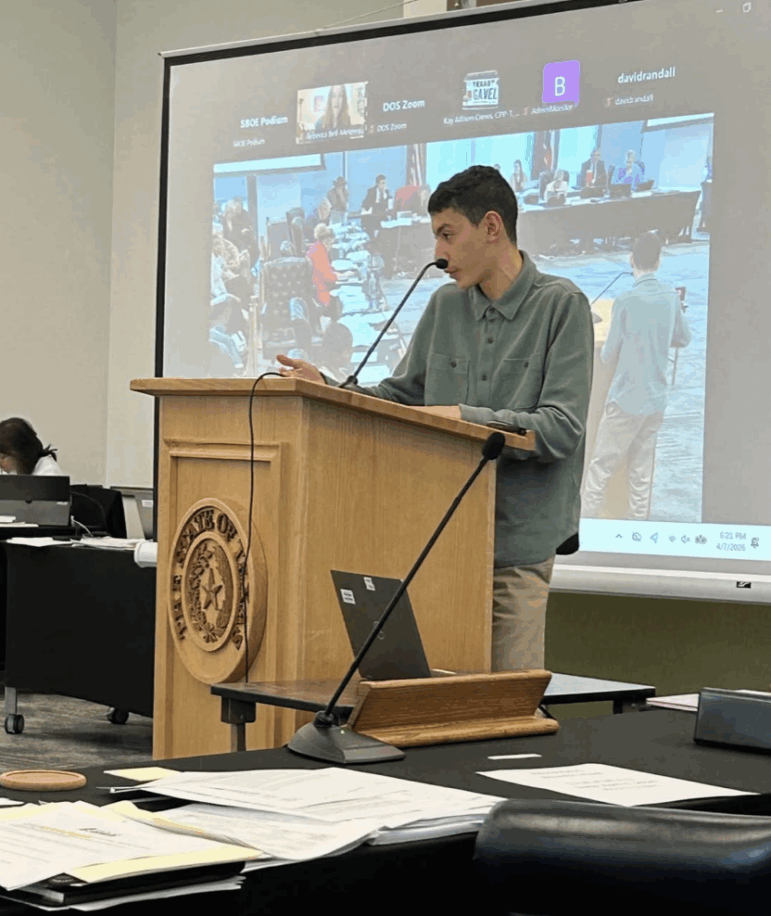
One of his biggest tasks in preparing for testimony, aside from homing in on flaws in specific TEKS, was crafting his message in a way that would be received as respectful. He was very aware that SBOE members might perceive a 14-year-old confronting them over a contentious issue as “bratty.” He especially wanted to avoid unintentionally alienating board members who supported inclusive and accurate TEKS. Even a statement like, “this is shameful,” felt too confrontational and risky. Aside from his age, Abdurahman had to consider another aspect of his identity: his religion. Abdurahman and his family are Muslim, and he worried some members would generalize any sign of disrespect to all people who support Muslim rights.
Education Advocacy Inspired by Faith
As a Muslim, one of Abdurahman’s motivations for returning each meeting was a teaching that people should oppose injustice in their hearts, and if they are able, to address it with their voices and hands as well. Another was the anger and frustration he felt seeing the disrespectful treatment doled out by some board members to women wearing a hijab; the hypocrisy of people who profess to support women actually oppressing them was upsetting. “This is wrong, this can’t stand,” he thought.
Empathy in the Face of Hate and Fear
Fortunately, Abdurahman didn’t experience much Islamophobia directed at him, perhaps because he’s a teenager, or perhaps because he is not easily identifiable as a Muslim based on his outward appearance, the way a woman in a hijab would be.
But as the year went on, more and more anti-Muslim speakers showed up at meetings.
“What was really disheartening was seeing 20 people in a row be like, ‘I’m here to talk about the presence of Sharia in the curriculum, and why Muslims are terrorists.’ They would have 20 in a row and we would have one person who would then get attacked by the board members–by Ms. Pickren and Mr. Hall.”
He remembers talking with students from a Christian church who wore matching anti-Sharia shirts. None could provide a definition of Sharia to him and his mother.
On at least one occasion, a board member supportive of the proposed TEKS told him something along the lines of, “I don’t agree with you, but thank you for coming.” It felt more dismissive or patronizing than sincere to Abdurahman. He wanted to respond to meaningful questions.
Some board members, though, approached him outside of the meeting room and genuinely conveyed that they were happy to see teenagers like him advocating for their rights and other people’s rights. They, and members of the community, felt bad about the expressions of anti-Muslim sentiments. Member Marisa Pérez-Díaz even addressed the Islamophobia head-on in the meeting itself. That empathy was welcome.
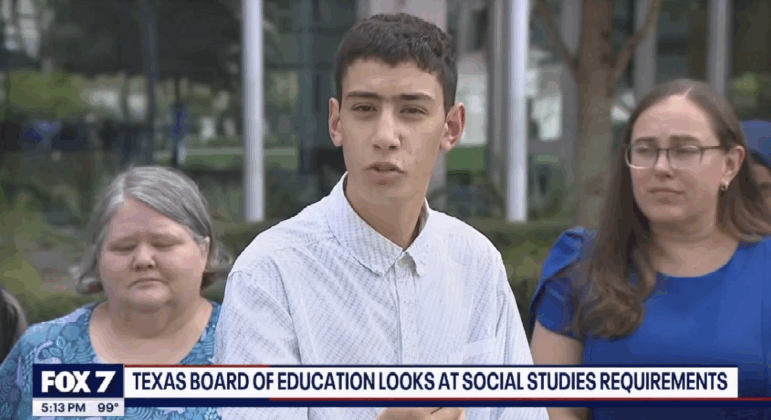
“The kid is right.”
Support came from outside the Barbara Jordan building, as well. When a right-wing Christian group posted disparaging remarks about Abdurahman’s testimony, the overwhelming response from commenters was, “the kid is right.” It felt good to see that, despite a hearing room filled with people who hate and fear his religion, like-minded people were out there.
“When you’re spreading that good, you’re being a patriot.”
Sometimes Abdurahman wondered what the point of going through the trouble of testifying was, when the outcome seemed predetermined. And for him, again it came back to his faith.
“It’s not about convincing the board members anymore. The ones that are Islamophobic have already shown that they’re not willing to listen,” Abdurahman explained. “The point is to educate the public. In Islam–and I’m sure other religions–there’s a concept: you educate one person and whatever benefit that education brings them is on your scale of good deeds, or is credited towards you by God. And I’d like to share that, maybe they don’t believe that God will give them that, but at least know that whatever tiny shred of information even one single person can benefit from-that’s on you, and you should feel proud of yourself for spreading good in this country where forces of hate and racism are becoming rampant and overwhelming. So when you’re spreading that good, you’re being a patriot.”
Our SBOE Advocacy Impact Series features four Texans who’ve advocated for inclusive, accurate, unbiased social studies standards. Read the other three profiles below!