When Kiyomi Beach decided to dive into advocacy, she asked herself how she could contribute in a way that allowed her to speak from her own lived and personal experience. She knew someone who was serving as a work group member providing feedback on a new social studies curriculum to content advisors appointed by members of the State Board of Education (SBOE). With a four-year-old about to enter school, the consequences of the SBOE’s decisions felt all too real. And as a Japanese-American, she felt a vested interest in making sure her family’s history wasn’t erased or sanitized. The choice seemed clear: Kiyomi would advocate for the preservation of history. She would fight for accurate and inclusive social studies standards.
Inspired by her heritage
Kiyomi’s great-grandparents immigrated to the United States from Japan. During World War II, the government surveilled her grandfather and confined his movement within the city limits. The government also incarcerated her grandmother and her grandmother’s siblings. Her family passed down this painful history, but Kiyomi was keenly aware that many Texas students had limited awareness of the systemic incarceration (often referred to as internment) of citizens and legal residents of Japanese descent.
While the current high school social studies standards, or Texas Essential Knowledge and Skills (TEKS), do require students to “analyze major issues of World War II, including the Holocaust, the internment of Japanese Americans as a result of Executive Order 9066, and the development of atomic weapons,” they don’t provide much guidance beyond that. How many Texas children, for example, grow up learning about the South Texas internment camp in Crystal City? That camp detained Japanese, German, and Italian families for months to years. How many students learn that the Peruvian government deported Japanese people to the U.S., which imprisoned them in Seagoville and a camp near San Antonio? In a state that often over-emphasizes Texas’ role in history, these omissions feel intentional. Kiyomi knew she could advocate for the inclusion of that history in the TEKS in a way most Texans couldn’t.
“We need to teach history that doesn’t just tokenize people.”
For Kiyomi, though, this is not just personal. She worries about the effects an incomplete, biased education will have on the individual and societal levels. “We have not learned from our past. We are not preparing kids for what’s next. We’re not equipping them to be critical thinkers,” she said. Kiyomi points out that producing uninformed or misinformed graduates will have implications for our competitiveness on the world stage.
“You can’t let go of hope”
To speak up for inclusive, accurate social studies standards, Kiyomi shared her thoughts in television and print interviews and testified before the SBOE. At the meetings, she saw clearly that the majority on the board aimed to push Christianity into school, downplay negative aspects of Texas and U.S. history, and support TEKS not grounded in fact. “If you saw what was happening, you would be appalled,” she said, citing a “pure disregard for truth.”
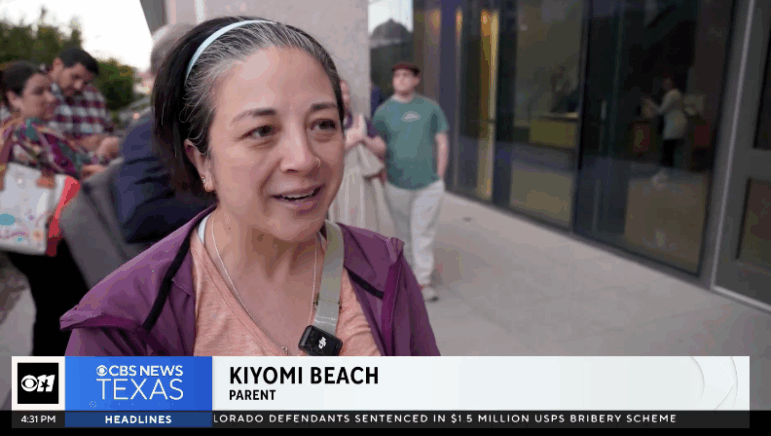
She lamented that there were not more parents there to witness what was happening and raise their voices, too. “I wanted my voice heard,” she insisted. Kiyomi felt it was important to expose what was happening.
And while there were not as many parents testifying as Kiyomi would have liked, the students who showed up inspired her. “Watching young people testify…that made me feel like there’s hope. I know that the tide will shift,” she said, “but only if we speak out.”
Our SBOE Advocacy Impact Series features four Texans who’ve advocated for inclusive, accurate, unbiased social studies standards. Read the other three profiles below!