By Andrew Freeman
Governor Abbott and his far-right cronies pushed for vouchers for more than a decade. It took millions of dollars, countless special sessions, and ousting the rural Republicans who opposed him to make it happen, but it happened. All for the benefit of Abbott’s billionaire donor elites.
TFN and countless others sounded the alarms. Again and again. Just look at states like Arizona or Florida: disaster was a foregone conclusion. One year after Abbott signed the school voucher bill into law, Texans are already seeing the dire consequences of vouchers play out… and those first taxpayer dollars haven’t even been dispersed.
But this isn’t an “I told you so” moment. Instead, we won’t stop sounding the alarm because we know it’s not too late. As the strain on our public schools increases and our kids pay the price in the classroom, we must first find what’s burning before we can put out the fire. So here are five ways vouchers are already harming Texans:
1. Vouchers are proving to be taxpayer-funded aid for private schools rather than for the students who really need it, leaving public school families behind.
In May 2026, the second round of school voucher award notices went out, now totaling nearly 96,000 students. According to reporting by Courier Texas, more than half of those recipients are already enrolled in private schools.
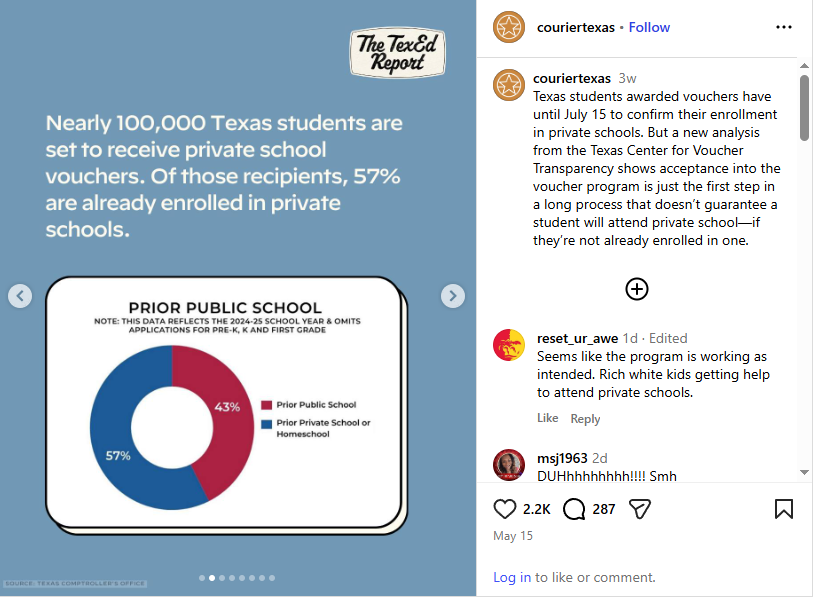
Credit: The TexEd Report, Courier Texas
White students are overrepresented among recipients, with Hispanic students at 27%, Black students at 16%, and Asian or Pacific Islander students at just 6%. Now compare that to findings from the Texas Tribune on the same issue, which notes 24% of Texas’ 5.5 million public school students are white, 53% are Hispanic, and 13% are Black.
All children should have the freedom to learn and pursue their dreams. Your race, zip code, faith or household income shouldn’t matter, and yet, vouchers subsidize the privileged with the very tax dollars meant for everyone’s future.
And it gets worse.
2. The new voucher law is enabling private and religious schools to discriminate with your tax dollars.
According to an analysis by the Texas Center for Voucher Transparency, 63% of the 59 private schools they reviewed are explicitly religious institutions. And 36% of those schools openly account for religious preference in their admissions process. Some even have parish vs. non-parish tuition rates.
This doesn’t just mean non-Christians are getting turned away. The Texas Observer looked at all 291 schools selected by the state and found more than 60 have written policies that discriminate against LGBTQIA+ students.
These admissions are heavily gated, sometimes requiring a tour, an interview or acceptance being contingent on a subjective “fit” review. In other words? These schools can turn just about anyone away, and they don’t really even need a reason.
Don’t forget, it took a court order for Islamic schools to be accepted into the voucher program to begin with.
The state is barred from offering any protections, and yet these private schools aren’t even the ones footing the bill.
3. Public schools are paying the price for a system that’s already pulling tax dollars away from them in the first place.
Schools are closing at Pasadena ISD. Austin ISD is facing a $181M deficit. El Paso ISD is on the verge of declaring a financial emergency.
These aren’t isolated incidents; they’re crises facing districts across the state. In fact, Cypress-Fairbanks ISD is projecting a $67 million deficit for the upcoming school year, and leaders are blaming, in part, the state’s voucher program which provides $500 more per student than Cy-Fair’s own per-student funding.
Our public schools are failing. Despite a half-hearted effort last legislative session, teachers are once again begging the state to do more to help. It’s bad enough that private schools are getting this funding instead; there are other consequences too.
For example, the Texas voucher scheme has led to a surge in special education evaluations, with families garnering to be accepted into the program. And who has to complete these evaluations? Public schools, forced by the state to meet tight deadlines despite hundreds of more evaluations than in previous years.
According to the Houston Chronicle, districts across the state have had to work weekends, shuffle staff, and even contract out services to meet the deadline.
“Public schools are being forced to be the unpaid gatekeepers of these vouchers, and we didn’t want any part of this.” – Texas Rural Education Association and superintendent of Gunter ISD, Brandon Enos
But we’ll say it again… it gets even worse!
4. These same special needs students are losing guaranteed protections from the state.
Remember the analysis from the Texas Center for Voucher Transparency we mentioned earlier? Well, they also found that many private schools explicitly state that they do not provide special education services, and that admission may even be denied “if the school determines the student is not a ‘good fit’ based on their special education needs.”
Again, a private school can basically turn anyone away.
Students and families with special needs aren’t protected by the Individuals with Disabilities Education Act (IDEA) or other federal or state protections.
While public schools are required to have strict guidelines, resources and in-depth reporting metrics, there is no guarantee of accountability for student outcomes elsewhere.
No student should have to give up their rights to attend school. And yet, many public school students don’t have access at all.
5. The voucher scheme was passed to deliver education to “all” Texas families, yet rural Texans have been forgotten.
Texas is home to the largest rural population in the entire country.
Despite that, as of February, more than 150 of Texas’ 254 counties had no elementary, junior, or senior high school enrolled in the ESA program. It’s why rural Republicans fought so hard against vouchers for years: they knew their families would be the ones most harmed by this great con. After all, private schools or not, their tax dollars still have to help pay for the program.
About 70 percent of these schools are concentrated in greater metros like Houston, DFW, and Austin. And even for those students, equity isn’t guaranteed. Not only are ESAs lottery-based, but as we’ve explained, the admissions process for private schools is lengthy and arduous. Meanwhile, the local neighborhood public schools that serve most Texas children continue to lose ground.
A Two-Tier Education System
What we’re seeing is what we’ve been afraid of all along: the voucher scheme has created a two-tier education system with publicly subsidized private schools for the wealthy on top, and struggling neighborhood public schools on the bottom.
It’s no accident vouchers had their beginning in the Jim Crow South following de-segregation, to help ensure white children received far better resources than children of color in public schools.
The reality is, this scheme was designed to divide Texans and subsidize the education of elites who have the privilege of sending their children to exclusive or religious private schools.
The ship hasn’t sunk yet. It’s not too late to turn things around. Pay attention. Stay on your representatives. And demand our tax dollars go toward fully funding our public schools – not a discriminatory voucher program.
Want to stay in the know? Sign up for our Public Education alerts below!