
Last week, we brought you some choice selections from cryptic, hand-scribbled memos Texas State Board of Education member Don McLeroy wrote to curriculum writers preparing the latest draft of social studies standards (“More McLeroy Malarkey, Part 1”). Here is Part 2.
To the “World History Studies” writing team, McLeroy suggests a few additions to the timeline of important events and people, including this one:

“Abram called at ~2000 BCE”
The most surprising part of this particular comment may be that McLeroy opts for the modern academic designation BCE (meaning “Before Common Era”), rather than the traditional BC (or “Before Christ”). In contrast, current SBOE chair Gail Lowe in her instructions to the board called for a return to the “traditional nomenclature BC/AD” because it has been used “for centuries in Western civilization.” A cynical person might wonder why McLeroy has declared war on “Christ” in the social studies standards, but I digress…
The most obvious problem with the inclusion of this new standard is the “call” language McLeroy proposes. The very notion that Abram was “called” by God is a religious belief (taken from Genesis 12:1-20) and is thus unsuitable for highlighting in a history course. Moreover, scholars propose a wide variety of dates for the life of Abram — and many biblical scholars question whether a historical figure named Abram/Abraham existed at all. In any case, there is little consensus on the matter, and World History standards are no place to propose firm dates when the scholarly community disagrees.
Speaking of slipping more religion into social studies, McLeroy recommends a brand new standard in the “United States Government” strand:
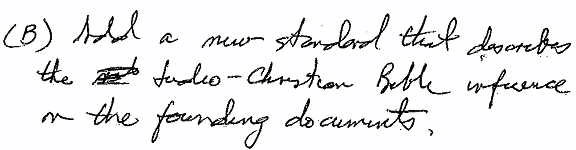 “(B) Add a new standard that describes the Jude0-Christian Bible influence on the founding documents.”
This is a tricky one — all the more reason why it would be better if a non-historian like McLeroy avoided making such suggestions. On the one hand, most historical scholars who work in this area would not dispute the fact that the Bible and Christian doctrine were a significant influence on many of the Founders. If McLeroy intends Texas classrooms to include the “Judeo-Christian Bible” as part of an even-handed, balanced account of the various ideologies that informed the Founders and influenced the nation’s founding, then we have no beef with such a discussion (apart from the deplorable grammar McLeroy proposes in this standard).
But there is reason to suspect otherwise, most notably the earlier advice from McLeroy encouraging committee members to “pay close attention to… David Barton.” Barton’s view of the Bible’s influence on the founders is anything but even-handed and balanced. Much has already been written on the bias and historical inaccuracies in Barton’s work — and TFN will soon release more evidence of these problems with Barton’s “scholarship” — but suffice to say here that almost all reputable scholars of the period would not describe Barton’s view of the Bible’s influence on the founding documents as mainstream scholarship. And if a Barton-esque treatment is what McLeroy has in mind for Texas textbooks and classrooms, then language like this in our social studies standards will surely mean problems down the road when textbooks are adopted.
And finally, a classic McLeroy-ism:
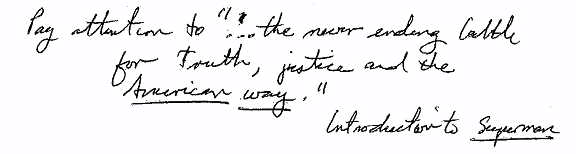 “Pay attention to ‘…the never ending battle for truth, justice and the American Way.’
Introduction to Superman”
I’ll give McLeroy this much — the man knows his 1950’s television. That quote is accurate and well-sourced. If only the rest of his comments were so reliable.